
The rapid rise of electric vehicles means millions of units will retire in the next decade. The global fleet could reach 240 million by 2030, creating a pressing need for safe, reliable material recovery.
The market for recycling has surged. Analysts expect growth from $3.5 billion in 2024 to more than $23.7 billion by 2035. Experts at Argonne note that processing fees fell from $15/kg in 2020 to about $7/kg today, improving economic viability.
The recycling process spans collection, transport, disassembly, material separation, and refinement. Each stage requires strong systems for management, compliance with evolving regulations, and tighter links to new production streams.
This introduction outlines why recycling is becoming central to a circular supply chain for electric transportation. Clear policies, smarter workflows, and shared information will determine how well the sector scales in coming years.
Key Takeaways
- Global vehicle growth drives urgent demand for battery recycling systems.
- Market forecasts show rapid expansion through 2035, offering new opportunities.
- Processing costs have dropped, improving the case for large-scale recovery.
- Effective management and evolving regulations are critical to scale-up.
- Integration with production supply chains will reduce environmental impact.
Understanding the Current EV Battery Recycling Cost, Challenges, and Future Trends
Understanding today’s unit recovery economics helps stakeholders plan for scale. Per-kilogram prices now range roughly from $1 to $15 depending on technology and throughput. A 500-kilogram pack can therefore cost about $500 to $7,500 to process.
Reports from McKinsey & Company and the IEA (2025) show that the total price is the sum of collection, transport, disassembly, separation, and material refinement stages. Environmental compliance adds roughly 5–10% to the per-kilogram expense.
The operational picture matters for fleet owners, plant operators, and regulators. Process choice and plant scale drive unit economics. Improvements in automation and sorting will lower per-unit fees over time.
Key takeaways:
- Per-kg variability: $1–$15 depending on method and scale.
- Pack example: 500 kg ⇒ $500–$7,500 to handle.
- Cost drivers: collection, transport, refinement, compliance.
Market Growth Projections for Battery Recovery
Market projections show a powerful compound annual growth rate for battery recovery through 2035. Analysts expect roughly 40.9% annual growth, pushing the recovery market toward an estimated $23.72 billion by 2035.
The International Energy Agency reports current global recycling capacity at about 2 million metric tons per year. By 2030, the supply of retired batteries for processing is forecast to reach 1.2 million metric tons.
More than half of end-of-life packs will come from electric vehicles by 2030. That shift will reshape how plants scale, where firms build capacity, and how materials like lithium, cobalt, and nickel are sourced for production.
Implications for industry:
- Ramping capacity will be required to match the rising supply of used batteries.
- Efficient material recovery will protect domestic supply chains for critical raw materials.
- Regulations and management reforms are needed to support safe, profitable expansion.
Comparative Analysis of Recycling Methodologies
Comparing major recovery methods shows trade-offs in energy use, output purity, and throughput. This section summarizes three leading approaches and how they perform on scale, recovery, and efficiency.
Pyrometallurgy
Pyrometallurgy uses high heat to melt and separate metals. It typically costs $5–$10 per kilogram and consumes roughly 3–5 MWh per ton of batteries.
Strengths: high throughput and robust handling of mixed chemistries. Example: Umicore’s Belgian facility processes about 7,000 tons annually with strong cobalt and nickel recovery.
Hydrometallurgy
Hydrometallurgy relies on aqueous leaching to dissolve targeted metals. It runs around $10–$15 per kilogram but can recover lithium at rates near 80–95%.
Note: Li-Cycle’s hub-and-spoke model shows how this process can scale while lowering carbon intensity and boosting material recovery.
Direct Recycling
Direct recycling aims to preserve cathode structure for reuse. If fully scaled, costs may fall to $3–$6 per kilogram.
Benefit: higher material fidelity and lower energy demand could improve supply chain sustainability as capacity ramps.
- Choose by chemistry: some methods suit specific pack types better.
- Balance: operational energy, purity, and unit price determine the right route.
- Long term: mixed approaches will likely coexist to meet rising demand for recovered metals.
The Role of Black Mass in Economic Viability
Black mass sits at the heart of material recovery and largely determines whether a plant turns a profit. This dark powder contains carbon plus nickel, manganese, and cobalt oxides and makes up roughly 60% of an end-of-life battery by weight.
Net value per unit from black mass recovery ranges from about $90 to $285. Using London Metal Exchange prices from May 2025, cobalt recovery can fetch roughly $298–$392 per metric ton, while nickel adds about $162–$213 per metric ton.
- Efficient black mass extraction raises facility margins and supports stable supply of battery materials for production.
- Information on composition helps operators tune leaching, sorting, and refinement to boost yield of lithium and transition metals.
- Processing capacity and purity are key competitive edges as the market for recycled materials expands.
As material prices rise, black mass economics will remain a central signal for investment and technology selection across the recycling value chain.
Factors Influencing Operational Expenses
Operational expenses hinge on design choices, plant scale, and the chemistry inside each pack. These three forces set the per-kilogram outlay for handling end-of-life systems.
Battery Chemistry and Design
Different chemistries require distinct methods. For example, NMC streams typically run higher per‑kg fees than LFP due to metal recovery needs.
Tesla’s structural pack raises disassembly effort by about 15–20% versus modular designs, which pushes labor and handling prices upward.
Scale of Operations
Volume dramatically lowers unit fees. Small facilities under 1,000 tons a year often face $10–$15 per kilogram. Large plants over 10,000 tons can drop below $3/kg.
Real-world example: Redwood Materials processes more than 20,000 tons annually, showing how capacity spreads fixed expenses and improves efficiency.
- Hydrometallurgy and pyrometallurgy have different energy and chemical inputs that affect running expenses.
- Safety systems and emissions controls add predictable overhead for complex chemistries.
- Standardized pack design will be crucial to reduce disassembly time and improve material recovery rates.
Technical Bottlenecks in Battery Disassembly
Disassembly stands out as the single most restrictive step in modern end-of-life handling for electric transport systems. The physical teardown creates the major throughput limit for many facilities.
Safety risk is a top concern. Thermal runaway and toxic exposure make manual disassembly hazardous for workers.
More than 20 distinct pack designs are in production today. That variety prevents wide adoption of robotic systems because machines need predictable layouts.
Standardization could change the game. Initiatives like the Global Battery Alliance’s Battery Passport aim to publish design data to speed the recycling process.
When disassembly is slow or crude, recovering key materials such as lithium and cobalt becomes harder and more wasteful. Efficient teardown improves material recovery and lowers emissions from downstream processing.
- Manual work is costly: labor‑intensive and risky.
- Automation is limited: lack of standard pack architectures blocks scale.
- Data helps: better design information boosts process efficiency and safety.
Infrastructure Limitations and Global Capacity
Global processing networks remain thin, creating a bottleneck as more end-of-life units enter the supply chain. Only about 25–30 commercial-scale recycling facilities operate worldwide. That small fleet handles a fraction of demand.
The current system can process roughly 30% of available retired packs. As a result, many units travel long distances to reach a plant. Transport raises emissions and adds handling risk.
Investment Trends
Capital flows are shifting to close the gap. PitchBook reports $3.2 billion flowed into new plants in 2024, a 65% jump from 2023. Green bonds also raised over $1.5 billion to back infrastructure.
- Limited facilities: 25–30 commercial sites globally.
- Under capacity: existing plants cover ~30% of end-of-life supply.
- Financing: $3.2B invested in 2024; $1.5B in green bonds.
- Technology mix: hydrometallurgy and pyrometallurgy are expanding to boost lithium and cobalt recovery rates.
- Regional hubs: local centers will cut transport costs and emissions while improving safety and efficiency.
Public–private collaboration is essential. Strategic hub development will allow material recovery to scale with production and protect domestic supply chains.
Regulatory Frameworks and Compliance Costs
Governments now tie permitting and market access to strict recovery targets and emissions limits. The EU Battery Directive requires 70% material recovery by 2030, a clear benchmark for plant design and process selection.
In the United States, EPA hazardous‑waste rules impose handling fees that add about $0.30–$0.80 per kilogram. Across major markets, overall compliance can raise unit expense by roughly $0.50–$1.00 per kilogram.
China enforces high performance: certain streams must reach 98% recovery efficiency. That level pushes operators to adopt advanced methods and tighter control of emissions and waste streams.
- Operational impact: stricter rules change plant layout, monitoring, and safety protocols.
- Strategic response: firms such as Li‑Cycle invest in emissions control systems to cut long‑term compliance spend by 25–30%.
- Market effect: fragmented standards slow cross‑border movement of spent batteries and materials.
Harmonized rules will make compliance costs more predictable and support wider capacity growth. Clear standards also improve safety, support efficient recovery of lithium and cobalt, and reduce emissions across the industry.
Emerging Technologies in Material Recovery
A wave of technology is helping plants extract more metals with less energy and risk. New biological and digital tools aim to improve yields while cutting emissions and manual hazards.
Bioleaching uses microbes to free valuable metals through low‑temperature processes. Pilot data show industrial scaling can reduce emissions by about 80% compared with high‑heat methods like pyrometallurgy.
Bioleaching
This method lowers energy needs and simplifies chemical steps. It also pairs well with hydrometallurgy for targeted recovery of lithium and cobalt.
AI and Machine Learning
Machine learning and spectroscopy speed sorting and boost material yields by roughly 30%. Digital twins simulate the recycling process to cut operating costs by about 20%.
- Robotics dismantle packs up to 100 times faster than manual work, improving safety and throughput.
- Direct recycling, as Argonne demonstrated, can reach 93% cathode recovery in trials.
- Combined, these methods make battery recycling more efficient and lower the sector’s emissions footprint.
Environmental Benefits of Circular Battery Management
Circular management of used packs cuts resource use and lowers emissions across the supply chain. By keeping metals and components in circulation, this model reduces pressure on primary mining and the related environmental harm.
Key impacts include an estimated 85% reduction in water use compared with traditional mining. Life‑cycle analyses show greenhouse gas emissions fall by about 80% when reclaimed materials replace primary feedstocks.
The move to material recovery keeps toxic waste out of landfills and protects local air and water quality. Efficient processes for reclaiming lithium and cobalt reduce the environmental burden of making new cells.
Economically, a circular model could lower raw‑material demand enough to save roughly $1 trillion globally. That saving strengthens supply security while supporting paths to net‑zero by 2050.
- Water: ~85% conserved versus mining.
- Emissions: ~80% lower across extraction and refinement.
- Waste: Reduced toxic streams and better local environmental outcomes.
Economic Implications for Fleet Operators
Fleet operators can turn end-of-life packs into predictable revenue streams with proactive asset management. Treating packs as recoverable assets changes budgeting and procurement decisions. Clear lifecycle planning helps capture value before final processing.
Predictive Maintenance
Predictive analytics extends service life by an estimated 15–25%. That extension reduces the frequency of replacements and improves total fleet uptime.
Amazon’s 2024 program reduced replacement expenses by about 18%, showing real gains from data-driven maintenance.
Operators who negotiate volume-based recycling contracts can cut per-unit fees by roughly 20–30%. A used but functional pack often holds market value between $1,500 and $5,000, offering a tangible incentive to manage end-of-life carefully.
Actionable steps for operators:
- Implement predictive programs to lengthen pack life and lower replacement rates.
- Secure volume contracts early to reduce per-unit fees and assure compliant handling.
- Track state-of-health to maximize secondary-use value and material recovery.
Result: better asset management improves efficiency, reduces waste, and positions fleets as key suppliers to the circular market.
Strategic Considerations for Recycling Entrepreneurs
Start with scale and supply. Most new operators need a minimum viable capacity of 500–1,000 tons per year to reach profitability. Small plants struggle with fixed overhead and per‑unit margins.
Plan long lead times. Permitting commonly takes 12–18 months, so secure permits early and budget for upfront project management and consultant fees.
Prioritize regional hubs to cut transport emissions and handling risk. Successful 2024–2025 models show that local processing lowers logistics spend and speeds turnaround for used batteries.
Match your chosen methods to the chemistry mix in your catchment area. Selecting hydrometallurgy, pyrometallurgy, or direct routes depends on available feedstock and desired material recovery.
- Scale: aim for 500–1,000+ tons to spread fixed expenses.
- Permits: allow 12–18 months for approvals and compliance setup.
- Partnerships: lock manufacturer agreements to stabilize feedstock.
- Method fit: choose recovery methods that suit local chemistries for efficient lithium and cobalt extraction.
- Compliance & safety: invest in systems to meet regulations and protect workers.
Adaptability is key. As vehicles and battery designs change, entrepreneurs who pivot methods and form strong supplier links will capture the most value in this growing market.
The Impact of Rising Material Prices
Stronger prices for key metals create a clearer business case for advanced recovery methods. Higher market values for lithium, cobalt, and nickel raise margins across the recycling process and make recovered feedstocks more competitive with newly mined supplies.
Price volatility can tilt revenue quickly. When raw-material markets surge, manufacturers shift toward reclaimed metals to manage exposure. That behavior increases demand for reliable material recovery and stable supply chains.
Investors respond by funding more advanced methods such as hydrometallurgy and pyrometallurgy. These technologies improve yields and lower emissions while scaling capacity at commercial facilities.
- Profit signal: higher metals prices boost facility returns and speed adoption of efficient methods.
- Market effect: volatility makes recycled materials an attractive hedge for producers.
- Stability: as demand grows, the industry becomes a steadier source of supply for vehicles and energy systems.
Future Innovations in Battery Design
Solid‑state and modular formats promise fewer hazardous components and easier teardown. Solid‑state cells reduce liquid electrolytes, lowering risk and simplifying material handling at end of life.
Designers now embed eco‑design principles so packs are easier to open and sort. Modular construction speeds disassembly and cuts labor time. That change helps plants recover lithium and cobalt more reliably.
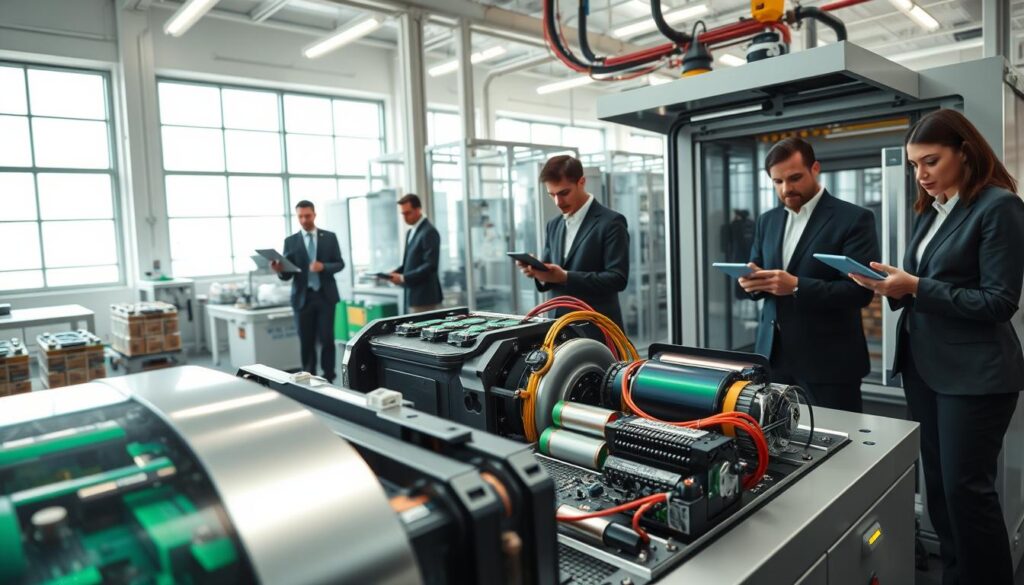
New architectures focus on clear material separation. When cells separate by design, downstream process steps use less energy and yield cleaner metals. Manufacturers working on lithium‑sulfur chemistries push for adaptive recovery methods to handle novel materials.
- Lower hazards: solid‑state and sealed formats reduce thermal risk and waste.
- Modular packs: ease disassembly and speed throughput for recycling centers.
- Built‑in separation: improves lithium and cobalt recovery rates and cuts emissions.
These design shifts align production with circular goals. By prioritizing sustainability and safety during manufacture, the industry will make material recovery more efficient and scalable for vehicles and energy systems.
Conclusion
Clear policy, better design, and smarter operations, will drive measurable gains in battery recycling over the next decade.
Costs should fall sharply as direct recycling, AI-driven sorting, and scale spread. That will make material recovery for lithium, cobalt, and nickel a reliable input to manufacturing. Regulatory mandates and expanding recycling facilities will speed deployment while improving safety and lowering emissions.
For fleets and entrepreneurs, the opportunity is practical: manage assets well, secure volume agreements, and adopt proven methods. The industry can turn end-of-life batteries into steady supplies of metals and materials that support cleaner vehicles and a more resilient energy market.
FAQ
What are the main methods used to recover materials from end-of-life lithium-ion packs?
The three principal methods are pyrometallurgy, hydrometallurgy, and direct recycling. Pyrometallurgy uses high heat to smelt cells and reclaim metals like nickel and cobalt. Hydrometallurgy employs acid leaching and solvent extraction to dissolve and separate constituents, offering higher recovery rates for lithium and cobalt. Direct recycling focuses on preserving cathode structure so active materials can be reprocessed with less energy. Each method has distinct capital, energy, and emissions profiles.
How does the concept of black mass affect profitability for material recovery firms?
Black mass — the mixed powder of cathode and anode materials after mechanical processing — concentrates valuable metals. Its composition and grade determine downstream recovery costs and revenues. Higher black mass purity cuts chemical use and boosts yields, improving margins. Conversely, low-grade streams raise processing costs and lower returns, making sorting and preprocessing crucial for commercial viability.
What factors drive operational expenses at recycling facilities?
Key drivers include labor, energy, chemical reagents, waste treatment, and compliance costs. Battery chemistry and pack design influence how intensive disassembly and processing must be. Scale matters: larger throughput spreads fixed costs, lowering per-unit expense. Logistics and feedstock variability also affect scheduling and inventory, adding to operating complexity.
Why is battery chemistry and cell design important for recycling efficiency?
Chemistry determines which metals are present and their concentrations, directly affecting recovery yields. Cell format and pack architecture influence how easily units can be dismantled. Modular designs with standardized fasteners and clear labeling enable safer, faster disassembly and reduce manual labor and contamination risks, improving overall efficiency.
What are the main technical bottlenecks in disassembling spent modules and packs?
Challenges include diverse designs across manufacturers, high-voltage safety risks, adhesive bonding, and integrated thermal management systems. Automated disassembly is difficult when components vary widely. Safe removal of electrolyte and managing residual charge require specialized equipment and trained staff, raising time and cost per unit.
How does global infrastructure limit recycling capacity today?
Limited processing plants, uneven geographic distribution, and constrained logistics create capacity gaps. Many regions lack facilities capable of handling high volumes or specific chemistries. Building new plants requires permitting, capital, and skilled labor, so growth often lags behind increasing retired pack volumes from fleets and passenger vehicles.
What investment trends are shaping recycling facility expansion?
Private equity, strategic investments from automakers and mining companies, and government grants are common. Firms often form partnerships with OEMs to secure feedstock and offtake agreements for recovered materials. Capital is flowing into both scale-up of existing hydrometallurgical plants and piloting direct recycling technologies that promise lower energy use.
How do regulations influence compliance costs for recyclers?
Regulations on hazardous waste handling, emissions, and landfill diversion require firms to invest in treatment systems, monitoring, and reporting. Extended producer responsibility (EPR) laws shift collection and financing burdens toward manufacturers, altering collection flows. Compliance costs vary by jurisdiction and can be a major line item for operators.
What emerging recovery technologies could change the industry mix?
Promising approaches include improved direct recycling that restores cathode active materials, bioleaching using microbes to selectively extract metals, and advanced solvent systems for cleaner hydrometallurgy. AI-driven process control and robotics for disassembly can also reduce labor and increase throughput. These innovations aim to lower energy use and raise material yields.
How does bioleaching work and where is it useful?
Bioleaching leverages bacteria or fungi to bio-oxidize battery material, mobilizing metals into solution under mild conditions. It can reduce chemical consumption and energy needs, particularly for low-grade or complex black mass streams. Scalability and residence time remain challenges, but it shows potential for niche applications where conventional methods struggle.
In what ways can AI and machine learning improve material recovery?
ML models optimize process parameters, predict feedstock composition, and detect anomalies in sensor data, improving yields and reducing downtime. Vision systems can speed automated sorting and disassembly. AI-driven predictive maintenance lowers unplanned outages, increasing facility uptime and lowering per-ton costs.
What environmental benefits arise from circular management of battery materials?
Recycling reduces demand for primary mining, cutting land disturbance, water use, and greenhouse gas emissions tied to ore extraction and refining. Recovering lithium, cobalt, nickel, and copper lowers supply-chain emissions and conserves finite resources. Proper treatment also prevents toxic constituents from entering landfills, protecting soil and water quality.
How do rising raw-material prices affect recycling economics for fleet operators?
Higher commodity prices improve the value of recovered metals, shortening payback on recycling investments and incentivizing collection. For fleets, this can lower total cost of ownership if recycled materials enter closed-loop supply chains or reduce procurement costs for replacement cells.
What strategic steps should entrepreneurs take when entering the material recovery market?
Validate a steady feedstock source via partnerships with OEMs or fleet operators. Choose a technology aligned with local regulatory and energy contexts. Invest in modular, scalable equipment to adapt to changing chemistries. Secure offtake agreements for recovered materials and prioritize health-and-safety systems to meet compliance and insurer expectations.
Which cell-design innovations will make next-generation packs easier to reclaim?
Standardized module interfaces, fewer adhesive bonds, clear labeling of chemistry, and designs that allow thermal and electrical isolation will aid safe disassembly. Cathode chemistries engineered for easier reconditioning or lower critical-metal content can also reduce downstream processing complexity and cost.
How quickly is the market for material recovery expected to grow?
Projections vary, but most analysts forecast rapid expansion over the next decade as vehicle retirements rise and regulatory pressure increases. Growth will depend on capital deployment, technological maturity, and how quickly stakeholders implement collection systems and EPR schemes to funnel used packs into licensed facilities.