
This section explains a protective operating state that cuts engine power so a car can still reach a safe spot. Most drivers see reduced speed and rev limits when the vehicle senses a fault. That drop in performance is deliberate, not random.
You will learn the common symptoms, likely triggers, immediate steps to stay safe, and why clearing a fault code rarely solves the root problem. Expect clear guidance for highway merges, stop-and-go traffic, and other U.S. driving scenarios.
The system is managed by onboard computers. They limit power and shift behavior to prevent serious damage to the engine or gearbox. Fixes range from simple fluid top-ups and fuse swaps to major repairs, so prompt diagnosis matters.
If the car cannot hold a safe speed or warning lights show a severe fault, stop safely and arrange a tow. This guide focuses on practical checks and realistic next steps for American drivers.
Key Takeaways
- Limp mode reduces power to protect the vehicle while keeping it drivable.
- Recognize common symptoms like low revs, limited speed, and altered shifts.
- Address the underlying fault rather than just clearing codes.
- Costs vary from minor fixes to major engine or gearbox work.
- Prioritize safety: stop and tow if the vehicle cannot maintain traffic speed.
What BMW Limp Mode Is and Why It Happens
When sensors report values outside safe ranges, the car will switch into a protective state. This deliberate strategy reduces stress on the engine transmission and keeps the vehicle drivable long enough to reach safety.
What changes immediately: power output drops, rpm limits are lowered, and the control logic shifts more conservatively. Those limits stop further damage by reducing heat, load, and aggressive gear changes.
How the control units decide
The engine and transmission control units constantly compare sensor readings against expected ranges. If a sensor or system reports an abnormal value, the unit assumes the reading may represent a real problem.
Minor faults, like a low fluid level or a flaky wiring connection, can look severe to the computer. The result is a safety response rather than a diagnosis.
Why understanding this helps
- Symptom management: limp is an alert that a problem exists, not the root cause.
- Short-term mobility: the system lets you reach a safe spot but not continue normal driving indefinitely.
- Next steps: use warning signs and codes to guide proper troubleshooting and repairs.
BMW Limp Mode Symptoms and Warning Signs to Watch For
A sudden drop in drivability often signals a protective restriction has been applied. Read these common signs so you can decide whether to slow and find a safe spot or seek help.
Sudden loss of power and reduced performance while driving
Expect sluggish throttle response, poor acceleration, and weak pulls on hills. This reduced performance makes passing and merging difficult.
Check engine light or engine management light illumination
The check engine light or engine light often stays on when the system limits output. The light is a key warning that a fault code exists even if the car keeps moving.
RPM and speed limits
Rev range may be capped around 2,000–3,000 RPM, with top speed limited near 30–50 mph. Early upshifts and a flat feel are typical.
Transmission and comfort changes
Shifts may be harsh or the transmission might lock in a low gear to protect itself. Non-essential items like air conditioning or cabin heat can shut off.
- Sudden power loss and sluggish throttle
- Warning light illumination despite drivability
- Rev and speed caps that reduce passing ability
- Transmission stuck in a low gear; comfort features off
One-time glitch may clear after a restart. If the same symptoms repeat, treat them as a persistent fault and follow diagnostic steps in the next section.
BMW Limp Mode: What Causes It and How to Fix It
A rapid drop in system pressure or an erratic sensor can trigger a protective power limit that keeps the car drivable while preventing further damage.

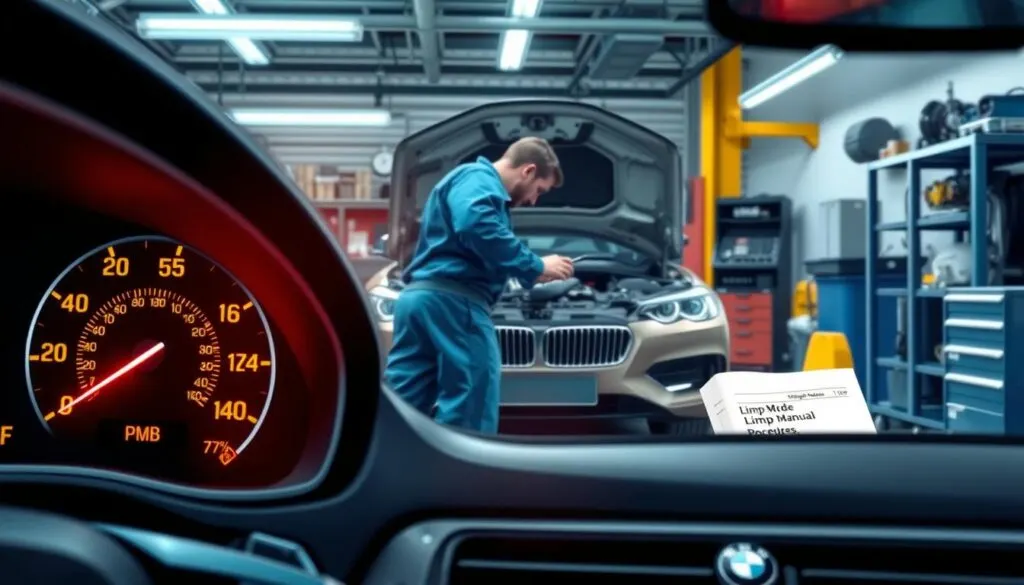
- Low oil or coolant levels: The engine may be de-rated to avoid overheating or lubrication failure. Top up fluids only as a stopgap; find and repair the leak.
- Transmission errors: Faults that stop normal shifting often force early upshifts or lock the gearbox in a low gear to protect internals.
- Engine problems: Misfires, turbo under-boost, or boost control faults make acceleration feel flat and can prompt the control units to cut power.
- Faulty sensors: Bad readings from sensors across engine and transmission systems can trigger reduced operation even when mechanical parts are fine.
- Wiring, fuses, brake hydraulics: Loom damage, blown fuses, or hydraulic leaks may cause no-starts or safety limits. Replace damaged wiring or fuses and repair hydraulic faults promptly.
Quick fix overview: restore correct fluid levels, replace failed sensors, repair wiring or fuses, fix boost leaks or actuators, then run full diagnostics before clearing fault codes. A certified mechanic can confirm repairs and reset the system safely.
What to Do Immediately When Your BMW Goes Into Limp Mode
When your car suddenly limits power, quick decisions keep you safe and prevent further damage. Stay calm, pull to a safe shoulder or parking area, and note any warning lights or unusual smells.
Safety-first decision framework: If the vehicle cannot maintain a safe speed for surrounding traffic, if the check engine light flashes, or if the engine runs rough or hot, stop and call for a tow or service. Do not attempt fast merges or highway driving with reduced power.
When it may be OK to drive slowly
You can drive a short distance at low speed to a nearby lot or service center if traffic is light and no red-flag symptoms appear. Avoid highways or steep grades where extra power is needed.
Quick under-hood checks
- Check oil and coolant levels visually; low levels may explain power limits.
- Look under the car for puddles or fresh leaks that signal rapid loss of fluid.
- Scan visible wiring and connectors for loose plugs, burned insulation, or obvious damage.
Red flags: rapid fluid loss, burning smells, smoke, or sudden overheating. If any occur, stop immediately and get professional help.
Restart procedure and what it means if the problem returns
Turn the car off, wait about 30 seconds, then restart. Note whether warning lights clear and whether normal power returns. A one-off glitch sometimes resets this way.
If the restriction returns right away or after a short drive, the control unit is still detecting a fault. That means the issue is unresolved and the best way forward is a diagnostic scan or towing the vehicle to a service center.
For next steps, read a full list of common fault codes and meanings in our fault codes list, then arrange repairs rather than relying on repeated restarts.
Diagnosing and Repairing the Underlying Problem
A scan of the car’s fault memory is the fastest way to find the troubled system. Reading trouble codes tells you whether the fault sits with the engine, transmission, brakes, sensors, wiring, or fluid levels.
Diagnostic flow that works: confirm stored codes, check live data for plausibility, inspect connectors and visible components, then test and repair before clearing faults. This prevents wasted parts swaps and speeds correct repair.
Common repair paths
- Restore correct fluid levels and fix leaks.
- Replace blown fuses or repair damaged wiring.
- Swap faulty sensors and repair boost-control components.
- Address transmission faults that stop normal shifting.
Resetting after repairs
A professional scan-tool reset is the best way to clear codes after verified repairs. A battery disconnect can reset some electronics but won’t fix a persistent fault and may erase settings.
Who should work on this
DIY is fine for low-risk fixes like topping fluids or changing a fuse if you have a scanner. An independent specialist often gives better value for deep diagnostics. Dealer service may be needed for complex module programming or warranty work.
Warning: bypassing protective limits risks major engine transmission damage and creates safety hazards. Always repair the cause rather than override the system.
Conclusion
This protective response keeps the vehicle safe by limiting power so you can reach a secure spot. Treat the mode as an alert, not a nuisance. Note any warning lights and slow down if traffic allows.
Quick steps: check basic fluid levels and look for leaks if it is safe. Record symptoms, then arrange a diagnostic scan. A clear error code helps a technician find the root cause faster.
Common problem groups include low fluids, faulty sensors, wiring or blown fuses, boost and air charge faults, plus transmission or brake hydraulic issues. Do not disable protective limits; that raises the risk of major engine or transmission damage.
Next up: schedule a qualified diagnostic appointment in the U.S. and keep proactive maintenance habits to reduce repeat events.
FAQ
What is the built-in protection strategy that limits drivetrain performance?
The vehicle uses a “limp home” safety routine to protect the engine and transmission when sensors report abnormal values. The system reduces power and locks out aggressive shifts so you can reach a safe location without causing further damage.
How does the engine control unit decide to engage the protection mode?
The ECU monitors sensors and compares readings to preset limits. If signals fall outside those parameters—such as extreme temperatures, low oil pressure, or fault codes from the transmission—the ECU restricts performance to prevent catastrophic failure.
What are the most common symptoms that indicate the car has entered this protective state?
Typical signs include a sudden loss of power, severely reduced acceleration, a restricted RPM range (often below 3,000 rpm), and a capped top speed that may feel like the throttle is intentionally limited.
Will a warning light appear when protection mode activates?
Yes. The check engine light or other engine management indicators usually illuminate when the system detects a fault that triggered reduced operation.
Can transmission behavior reveal that the system is protecting itself?
Yes. The gearbox may lock into a low gear, refuse to shift normally, or display erratic shift logic—behaviors meant to limit torque and protect internal components.
Why might climate functions like air conditioning stop working during reduced operation?
Non-essential loads such as A/C and sometimes cabin heat are often disabled to lower engine strain and electrical demand while the control system manages the fault condition.
Which fluid conditions commonly trigger protection mode?
Critically low oil or coolant levels can prompt immediate limits to protect against overheating and lack of lubrication. Always check fluid levels if you experience sudden power loss.
How do transmission faults lead to reduced performance?
Transmission errors—sensor failures, solenoid faults, or pressure loss—prevent safe shifting. The control system reduces torque and locks a gear to avoid slipping or internal damage.
Can engine misfires or boost problems cause this behavior?
Yes. Repeated misfires, under-boost from turbocharger faults, or intake problems can trigger protective limits to prevent further engine harm and to maintain drivability at low speed.
How often are faulty sensors responsible for the protective action?
Faulty or out-of-range sensor readings are a frequent cause. Oxygen sensors, MAF/MAP sensors, crank or cam position sensors, and transmission speed sensors can all provoke reduced operation if they report invalid data.
Could wiring, fuses, or connector issues cause activation?
Absolutely. Intermittent connections, chafed wiring in the loom, or blown fuses can create false faults and trigger safety limits even if the mechanical systems are healthy.
Do brake or hydraulic faults ever force the car into a safe mode?
Yes. Problems in brake-by-wire, hydraulic pressure, or related sensors can prompt the control units to restrict drive output to maintain safety until the issue is addressed.
Is it safe to keep driving slowly after the system engages?
That depends. If the fault is minor and temperatures/pressures read normal, you can cautiously drive to a nearby repair shop. If gauges show overheating, low oil pressure, or severe transmission problems, stop immediately and arrange a tow.
What quick checks should I perform under the hood when the car goes into protection mode?
Check engine oil and coolant levels, look for obvious leaks, inspect visible wiring harnesses and connectors for damage, and ensure the air intake is not blocked. These quick checks can reveal common, fixable issues.
Can a simple restart clear a temporary fault?
Sometimes. Restarting the engine can clear transient glitches and restore normal operation briefly. If the protective state returns, the underlying fault remains and needs diagnostic attention.
How do technicians diagnose the root cause of the protective state?
Mechanics read stored trouble codes with a scan tool to identify which system triggered the event. Live data logging, pressure tests, and targeted electrical checks then pinpoint the failing component or circuit.
What repair paths are typical once the fault is identified?
Common fixes include topping or changing fluids, replacing faulty sensors or solenoids, repairing wiring or fuses, addressing boost-control parts, and servicing or rebuilding transmission components when necessary.
How is the protective state cleared after repairs?
A scan-tool reset is the cleanest method to clear codes and reinitialize adaptive values. Disconnecting the battery can also clear codes but may affect radio presets and learned parameters.
When should I choose a dealership, independent BMW specialist, or DIY repair?
Use a dealership for complex engine or transmission overhauls and warranty work. Independent BMW specialists are often better for diagnostics and cost-effective repairs. DIY is reasonable for simple checks, fluid changes, and basic sensor swaps if you have the right tools and experience.
Is there a safe way to bypass the protective limits to keep driving normally?
Bypassing the safety strategy is risky. Doing so can cause severe engine or gearbox damage and lead to far higher repair bills. Always fix the root cause rather than trying to override the control system.